

Experimental Teaching Philosophy
With the rapid development of information technology, how to cultivate the next generation of electronic information engineers is an important topic worthy of our in-depth study, and how experimental teaching will play a role in the training of talents has also become the focus of our attention. Based on the profound understanding of the law of practical education, Tsinghua University puts forward the new concept of "innovative talents must be cultivated in innovative practice, and innovative practical education is the only way to the growth of innovative talents". The Department of Electronics summarizes the specific connotation of innovative practice in the discipline of electronic information science and technology, and establishes the general goal of cultivating innovative talents based on high-level discipline construction in the discipline of electronic information, cultivating excellent talents with innovative spirit and innovative ability.
The reform and innovation of experimental teaching will strongly promote the pace of Tsinghua University in building a world-class university. As a key department supported by Tsinghua University, the construction of experimental teaching is related to the quality of talent cultivation in the field of electronic information, and the construction of a world-class experimental teaching platform and high-level experimental courses is an important part of the strategic deployment of the Department of Electronic Engineering to create a world-class discipline. After deep research and practice, the Electronic Experimental Teaching Center has established the concept of experimental teaching and reform ideas.
The requirement for practical teaching is not only to provide an environment for talent innovation, but also to explore innovative talent cultivation mechanism. Talent innovation refers to the fact that innovative consciousness and ability should be cultivated for all students, which is the requirement of society to us. Innovative talents cultivation refers to the cultivation of talents with comprehensive ability and outstanding professional innovation ability, which includes the cultivation of top innovative talents.
Planning of Experimental Teaching in the Department of Electronic Engineering
The Department of Electronic Engineering has two primary disciplines ranked first in China: Electronic Science and Technology and Information and Communication Engineering, and six secondary disciplines under it, including Communication and Information Systems, Signal and Information Processing, Electromagnetic Field and Microwave Technology, Circuits and Systems, Physical Electronics, and Complex Networks and Systems, whose research content covers almost all fields of electronic information.
In order to carry out the need of cultivating innovative talents proposed by the central government and the Ministry of Education, the Department of Electronic Engineering has organized many seminars for teachers since 1999 on the curriculum system, curriculum setting, content arrangement of course teaching and practical teaching, etc. Based on the inspiration of modern learning theory, the orientation of experimental teaching in the Department of Electronic Engineering has been clarified. Clarify the hierarchical talent training, experimental teaching mode and experimental teaching system.
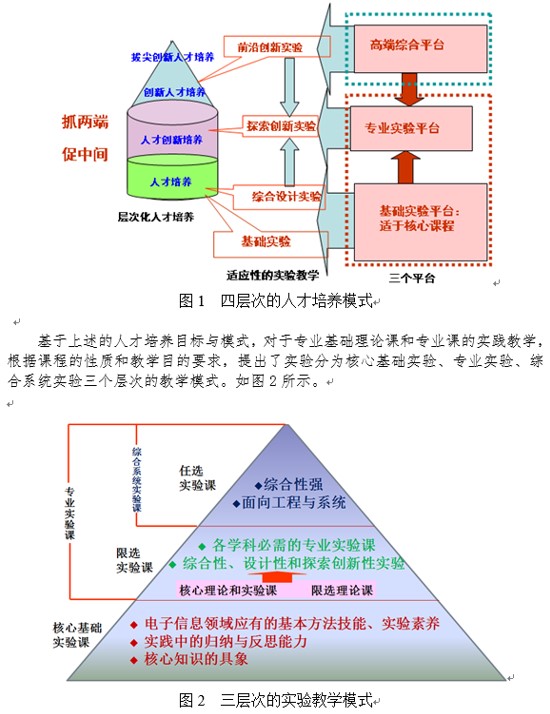
First of all, we clarify the hierarchical talent cultivation model of practice teaching, including four levels of talent cultivation, talent innovation cultivation, innovative talent cultivation and top innovative talent cultivation, as shown in Figure 1.
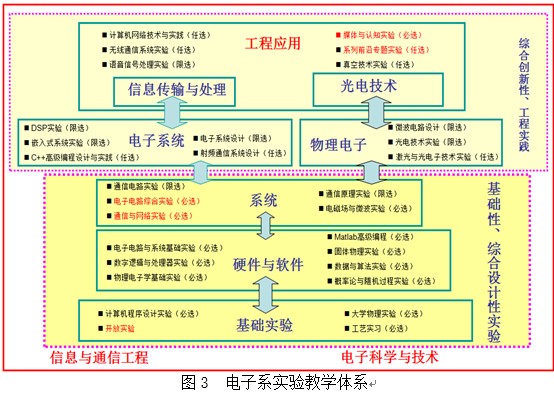
Further, combined with the study theory, we have deeply studied the discipline layout and characteristics of the Department of Electronic Engineering, and guided us to establish the practical teaching system of the Department of Electronic Engineering. Based on the two first-level disciplines of electronic science and technology and information and communication engineering, and based on the theories of circuits and systems, electromagnetic fields and waves, signal and information processing, electrons, the motion of photons and the laws of interaction in different media, and with the combination of practice and theory as the core, we enrich, develop and improve the series of experimental teaching in the Department of Electronic Engineering, cultivate students' comprehensive mastery and application of theoretical knowledge to solve practical problems It also cultivates students' preliminary scientific research ability, stimulates their innovative thinking and enhances their innovative consciousness; it forms the practical teaching system of the Department of Electronic Engineering. As shown in Figure 3.
Ideas of Reforming Experimental Teaching
Sort out the knowledge system of electronics department to establish the infrastructure of experimental courses
In the past three years, the Department of Electronic Engineering has vigorously implemented a comprehensive curriculum reform, sorted out the core knowledge structure of undergraduate electronic information science, taking "the interaction of information carriers and systems" as the core concept that unifies the knowledge structure of undergraduate electronic information science, and can put "field and matter ", "potential and circuit", "bits and logic", "data and algorithm", "packet and network "Media and Cognition" and other groups of interrelationships are unified and form a clear hierarchical progression, thus outlining the structure of the knowledge system of electronic information science and the overall plan of the curriculum designed on the basis of this structure. With ten core courses as the foundation of the profession, dozens of professional optional courses cover various professional knowledge and skills, and more professional optional courses cover the study of various engineering and system problems. At the same time, we further increase the efforts of practical education and teaching, and each of the ten core theoretical courses is equipped with corresponding experimental courses. Figure 4 shows the knowledge architecture of electronic information discipline. It is the roadmap of the curriculum reform of the Department of Electronic Engineering.